

Can you hand new homebuyers the bill for 99 percent of the cost of growth without making housing more expensive? According to the regional government for Metro Vancouver, the answer is simple: yes. Before 2023, the cost of new water, sewer, and park infrastructure was split roughly 50-50 between existing and new residents. Since 2023, existing homeowners would pay just 1% of the cost, while new construction would pay the other 99% through development taxes, one-time fees levied on new construction.
The chief administrative officer, Jerry Dobrovolny, defended the move: “The DCCs [development cost charges] will not change housing prices. And I know that may be controversial for some, but I will say that unequivocally to you all now. The DCCs will not change housing prices.”
How is this possible? You might think that taxes on new housing would raise costs for developers and reduce supply. Since fewer homes are built and the number of buyers is the same, prices must go up. But actually there is a way: when developers respond to the tax by paying less for land, housing prices do not rise. Though there is a limit. If the tax is too high, the landowner refuses to sell, and the new housing development becomes infeasible. With lower supply, prices rise.
So development taxes can be paid by landowners, but the tax needs to be carefully calibrated. To understand who ends up paying, let’s start with an example showing why cities use these taxes in the first place.
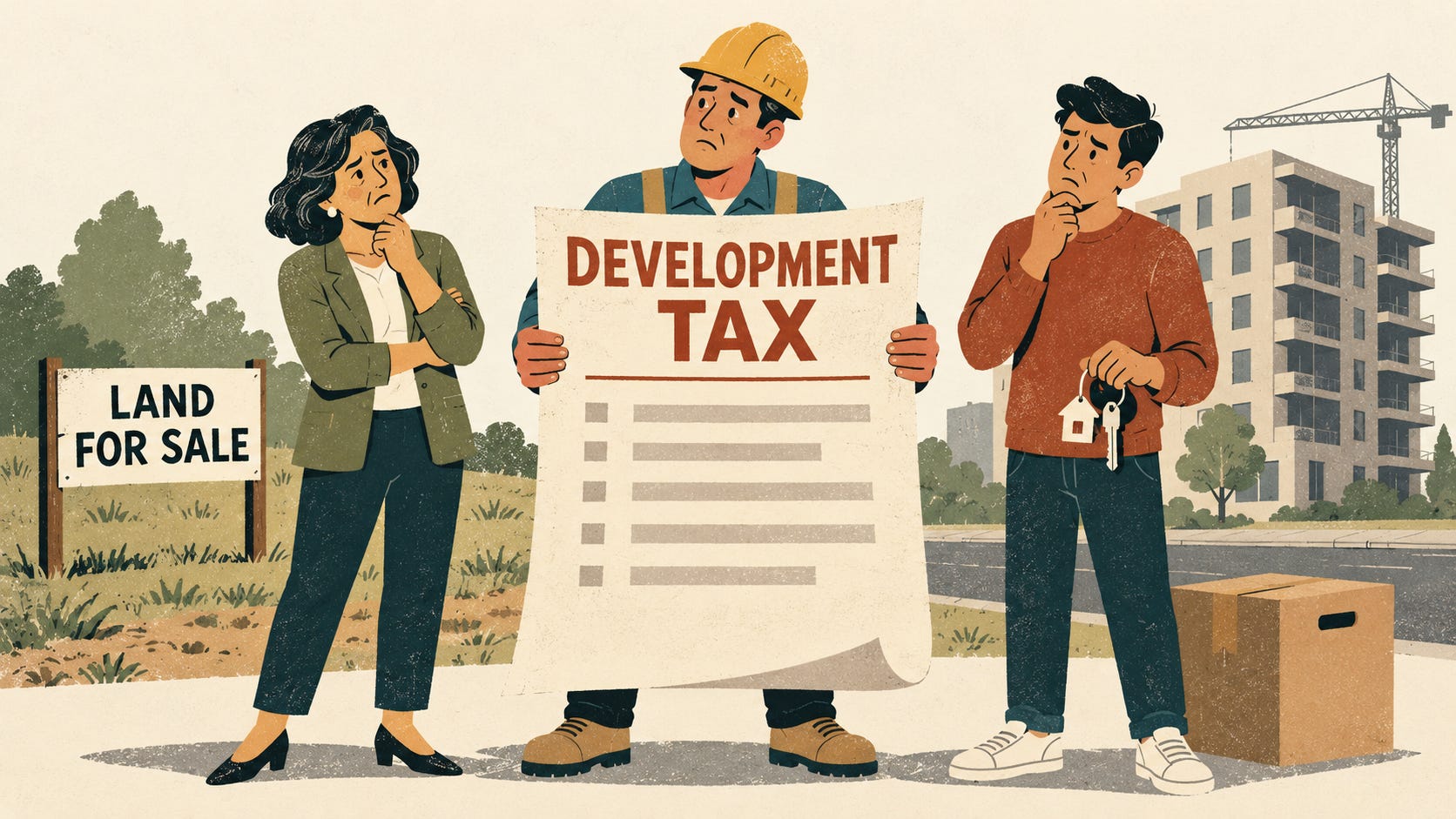
Who should pay for the costs of growth?
Imagine a city of 100 households, each owning a house. The sewer system needs to be replaced; the replacement will cost $1 million and last 20 years. If the 100 homeowners each pay $500 in property taxes every year, the city can borrow to fund the upgrades and pay off the loan over 20 years.1 (I’m assuming a zero interest rate for simplicity.)
Now suppose the population is growing, with 200 newcomers arriving in 10 years.2 The city must upgrade to larger sewer pipes today, at a cost of $3 million. But the new homes contribute property taxes only over the final 10 years, so existing homeowners pay for sewer capacity they don’t need for years 1 through 10. To cover the bill, property taxes must increase from $500 to $750.3
Now add a $5,000 development tax on each new home. Then property taxes can stay at $500, and the city still covers the full bill. Each resident pays $10,000 in total, so the sewers are upgraded by splitting the bill equally.4 It sounds like development taxes work, right?
It’s true that the city can balance its books. But we haven’t sorted out who actually pays the $5,000 tax, or whether the same 200 homes still get built.5
Who actually pays the tax?
There are three main actors involved: existing homeowners, newcomers, and landowners of empty lots. Developers are just middlemen: they buy land from landowners and build homes for newcomers. While the development tax is formally charged to developers, they can either pass it forward to homebuyers or backward to landowners.6 So we expect the tax to be paid through either higher home prices, lower land prices, or a combination of both. The question of who ultimately bears the tax is what economists call ‘tax incidence’.
When landowners pay
Suppose zoning caps the city’s housing stock at 300 homes, so at most 200 new homes can be built. Initially, home prices are $550,000. But more people want to move in than the city can accommodate, so competition among prospective newcomers pushes prices up to $600,000.
Let’s say that each home costs $500,000 to build, including labor, materials, and a normal return for the developer. That leaves $100,000 left over to pay for land (known as the ‘residual land value’). Suppose the landowner’s next best use is a parking lot worth $50,000; then landowners are happy to sell to a developer, and each of the 200 new homes is feasible to build.
With no development tax, the landowner sells to a developer for $100,000, which is a $50,000 profit compared to using the land as a parking lot. This $50,000 is surplus land value that can absorb the development tax. (Why don’t developers pay less for land? Because another developer could offer more and still earn a normal return.)
So when the $5,000 tax is in place, the developer can shrug to the landowner and say their land budget is now only $95,000. The landowner is still better off taking the deal than selling the land for $50,000 to use as a parking lot, so they agree. (Why don’t developers pay the same for land and raise home prices to $605,000? Because neither supply nor demand has changed: the same 200 homes are sold to the same 200 buyers.)

In this example, the full amount of the development tax is paid by the landowner. There’s no change in the quantity or price of new housing, compared to not imposing a tax. Exactly as Mr. Dobrovolny foretold, the tax does not raise housing prices!
This scenario represents one theoretical edge case. The same 200 new homes are built with or without the $5,000 tax, because population growth increases demand while the city’s housing supply is capped. Economists call this “perfectly inelastic” supply.
In fact, we could raise the tax to just below $50,000, the full amount of the surplus, with no change in construction or home prices. But taxing any more than that would cause some landowners to back out, since the parking lot becomes more valuable. This reduces how many new homes are built, which in turn raises home prices. Developers cannot simply add the tax to the price while selling the same number of homes to buyers with the same willingness to pay.
When homebuyers pay
Now consider the opposite case. There is no cap on housing supply, and developers are able to produce any number of homes at a constant cost. This is known as “perfectly elastic” supply. When demand increases, developers can build enough new homes that prices stay at the initial level of $550,000. At this price, suppose 400 newcomers move in.
But if home prices don’t rise, then developers can barely buy land, since their land budget is equal to the landowner’s alternative use. There’s no surplus land value. What happens now when we impose the tax?
In this case, the landowner won’t accept $45,000 when the parking lot is worth $50,000. There is no wiggle room to absorb a tax. In fact, at the original home price, the surplus land value is actually negative. So new homes must sell for $555,000 to cover the extra cost of the tax.
At this higher price, suppose only 375 newcomers are willing to buy, rather than 400. The result is 25 fewer homes and a $5,000 higher price. The tax works by pricing out the buyers with the lowest willingness to pay; the remaining buyers can pay the higher price, which is what allows developers to afford to buy land.

So when supply is perfectly elastic, the effects of the tax are reversed: landowners pay nothing, and developers pass the tax fully to homebuyers in the form of higher prices. Contrary to Mr. Dobrovolny, the tax reduces the quantity and increases the price of housing.7 To justify his promise that development taxes won’t raise home prices, we need to see evidence that taxes do not reduce construction.8
Between these two extremes of perfectly inelastic and perfectly elastic supply, we can have any middle case where a development tax is paid partly by landowners through lower land prices, and partly by homebuyers through higher housing prices.9
Who benefits from growth?
The fairness argument for development taxes is that existing homeowners shouldn’t have to pay for the costs of growth. In our example, imposing a development tax paid for the sewer upgrade with no additional property taxes on existing homeowners. This holds regardless of whether developers pass the tax backward to vacant landowners or forward to new homebuyers.
But so far, we’ve been counting the costs of growth without also counting the benefits. In the supply-constrained city, population growth pushed home prices from $550,000 to $600,000. So when there’s no development tax, existing homeowners pay an extra $5,000 in property taxes over 20 years, but gain $50,000 in property value. In this scenario, existing homeowners are clearly net winners from growth, even though their taxes pay for sewer capacity they don’t use.10
If existing homeowners benefit through higher property values, then it’s only fair that they pay for some of the costs of growth: charging them higher property taxes is actually a fair way of splitting the bill. The unfair policy is charging a development tax on new housing without accounting for the benefits received by existing homeowners. The tax burden falls on homebuyers or landowners, while existing homeowners get a positive externality.
More precisely, population growth increases the value of land, separately from the value of the buildings on top of it. That value is created by growth making the location more desirable, so it should be used to pay for the costs of growth. Here, a property tax is like a partial land value tax, since it applies to both the land and building components of property value.
Ideally, we would use a 100% land value tax to capture the full $50,000 in land value uplift from existing homeowners, and use that to pay for the sewer upgrade.11 This is the natural way to make growth pay for growth. And a land value tax would also capture land uplift from landowners of development sites. The problem with development taxes is that they miss the land uplift that accrues to existing homeowners, and hence are an incomplete form of value capture.
To be fair, there’s no guarantee that the land uplift will be enough to pay for the total cost of infrastructure upgrades. Or, population growth might not raise land values at all, as when housing supply is highly elastic. In these cases, development taxes can be justified to make up the difference.12
So the phrase “growth pays for growth” should mean more than making newcomers pay for their own costs. Instead, we should understand the general principle as “the benefits of growth should pay for the costs of growth”. Since growth increases land values, we should tax land to pay for the infrastructure upgrades that sustain that growth. Existing homeowners should not get to benefit from growth while foisting the costs onto everyone else.
100 * $500/year * 20 years = $1 million.
So there are 200 landowners of empty lots that are used as development sites. Assume these empty lots pay $0 in property taxes (or that the tax is a sewer charge for connected homes).
Aggregate costs:
Existing homes: 100 * $750/year * 20 years = $1.5 million.
Newcomers: 200 * $750/year * 10 years = $1.5 million.
Taxes go up because new infrastructure capacity needs to be installed before people move in. If all newcomers arrived immediately, they would pay taxes over the full 20 years, and property taxes would stay at $500.
Existing homes: 100 * $500/year * 20 years = $1 million.
Newcomers: development taxes: 200 * $5000 = $1 million; property taxes: 200 * $500/year * 10 years = $1 million.
The newcomers pay for twenty years of infrastructure, but only use it for ten years before it needs replacing. This is partly an artifact of focusing on a single infrastructure project; with many projects with differing timelines, these costs can be smoothed out.
Another possible solution is the ‘pay it forward’ model: you pay for the costs of the next generation, but you also benefit from contributions made by the previous generation (compare: pay-as-you-go pension system). This depends on consistent growth and regular, equally-sized infrastructure upgrades, so each generation is paying a similar amount. These assumptions are more likely to hold in an established city; there is no previous generation in a new town. Switching from pay-as-you-go to development taxes can introduce unfairness, since the last old generation doesn’t pay it forward.
Developers bear the statutory incidence, but the economic incidence falls on homebuyers or landowners. Under perfect competition, developers make a normal return, that is, zero economic profit. If you’re making a profit, I can undercut you by taking a lower profit and bidding more for the land. Similarly, the developer would refuse projects that don’t earn a normal return, because they would rather invest in the stock market.
And this matters for paying off the sewer upgrade. Suppose with 400 newcomers, upgrades would cost $5 million. If we set the fee assuming 400 newcomers, but only 375 arrive, then we’ll face a revenue shortfall. And if we respond by increasing the tax to $6000, more buyers will drop out, requiring yet another tax increase, and so on in a feedback loop.
Metro Vancouver’s own study found that the DCCs would make townhome and apartment projects infeasible, thereby reducing supply and raising prices. It is bewildering that the Chief Administrative Officer could be so confidently wrong.
This discussion is slightly simplified. In the inelastic case, imposing a development tax of $5000 reduced annual property taxes from $750 to $500, so newcomers save $250/year * 10 years = $2500 in property taxes. So even though they pay an upfront tax of $5000, the increase in total taxes is only $2500. In theory, buyers account for this reduction in future taxes, which allows them to increase their housing budget today.
So we need to model an additional increase in housing demand by $2500. With inelastic supply, this demand shift is fully passed into housing prices; and because supply is inelastic, developers pass this higher price to landowners. So in the final accounting, housing prices rise by $2500 (to $602,500), and land prices fall by $2500 (to $97,500). When supply is inelastic, the tax is a transfer from landowners to existing homeowners.
Note that this is not an increase in total housing costs for homebuyers, since the higher purchase price just reflects lower future property taxes.
One counterargument: if all housing in the market has increased in price, then any gains from selling are wiped out when you buy a new home. But there are multiple ways homeowners can benefit from capital gains. Suppose they’re planning to downsize from a house to a condo; if house prices rise from $1M to $2M, and condo prices rise from $250k to $500k, then they benefit. Or if prices rise in city A but not in city B, the homeowner can move to B and pocket the profits; they gain overall if the costs of living in B are less than the gained property value.
Land value tax is more efficient than a property tax, since the latter taxes buildings and deters development.
If growth has a negative effect on land values, because congestion worsens more than amenities improve, then land value tax revenue would fall. In this case, a development tax would be justified.