

It’s uncontroversial that rich tech workers moving into your city is bad news for low-income renters. Wealthy newcomers can buy old rental homes and renovate them, evicting tenants. Or they snap up the high-end three-bedroom homes, forcing middle-class renters to downgrade to a two-bedroom, which in turn pushes working-class renters into one-bedrooms. And when more people are competing for the same number of one-bedroom apartments, rents go up. This is a demand cascade, where competition at the top of the housing market spills down to the bottom.
But if high-end housing demand can raise low-end rents, doesn’t it follow that adding high-end supply would reduce them? This view is more controversial, but the answer is yes. When we build a luxury condo, a rich household moves in and vacates their previous home; this allows a middle-class family to move in, which in turn frees up another home, and so on. This vacancy chain reduces rents for lower-quality housing, even though a working class renter couldn’t afford to live in the luxury condo.
While vacancy chains are more contentious than demand cascades in public discourse, the standard view among economists is that high- and low-end housing markets are connected. We have strong evidence from economic theory and empirical studies that changes to either high-end supply or demand can propagate down and affect prices at the bottom end of the market. More surprisingly, supply and demand changes at the bottom can move upwards and affect prices at the top.
A useful metaphor for the housing market is a ladder. The rungs are levels of housing quality, measuring the number of bedrooms, age, and location. When tech workers move in and cause a demand cascade, they push people down the ladder. The person on the bottom rung falls off, meaning they have to double up with family or move away. Similarly, building luxury condos adds a rung to the top of the ladder, starting a vacancy chain where everyone moves up by one rung, ultimately freeing up a space at the bottom.1
Wait a minute, isn’t this trickle-down economics?
At first glance, building high-end housing to reduce low-end rents might sound like “trickle-down economics”, where tax cuts for the rich are supposed to create jobs for the poor. But tax cuts involve a public budgetary cost, because we have to give up tax revenue. In contrast, upzoning is free: when zoning is a constraint, we can get more market-rate housing at the stroke of a pen just by relaxing the zoning rules.2
To avoid confusion with tax cuts, we should stop using the ideologically charged term “trickle-down”. Instead, I propose “housing ladder spillovers” as a neutral description for movements across submarkets. Changes at the one end of the ladder can have effects at the other end, and this is just how you would expect a system with multiple connected levels to work.
Demand cascades: high-end demand raises low-end rents
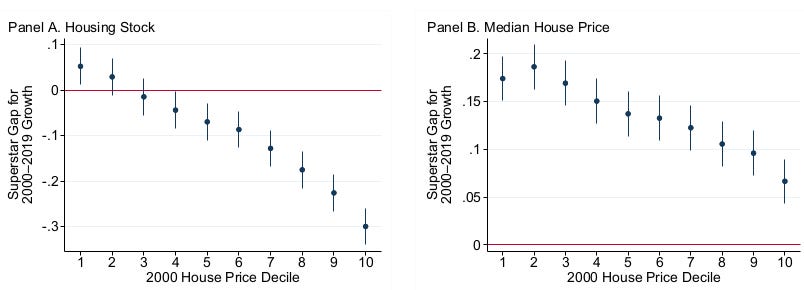
In the last few years, economists have begun to take demand cascades seriously. Nathanson (2026) compares eight superstar metros to other metros over 2000-2019, and reports two main findings. First, superstar metros have lower supply growth (relative to other metros) at the top end of the market; see Panel A below, where more expensive homes are on the right. You would expect this to mean prices also grew faster at the top end, but in fact, price growth was higher at the bottom end (Panel B). This suggests a demand cascade caused by rich people not being able to find high-end housing. Corroborating this interpretation, Nathanson shows that the college-educated population increased in the low-quality segments, while the non-college population shrank.3
We also have several papers building models to show how the housing ladder works. Abramson and Landvoigt (2025) focus on San Francisco and simulate a demand cascade. They remove housing from the top of the ladder and convert it into low-end rental housing by downgrading its quality. Then rich households need to find a new place to live, so they move down the housing ladder and outbid poorer households. The simulation shows that removing high-end supply increases housing prices across the top three-quarters of the housing ladder.4
Fonseca, Liu, and Mabille (2026) study a housing ladder with three rungs: rental housing, starter homes, and trade-up homes. They show a demand cascade caused by increased demand at the top of the ladder, for trade-up homes. In their simulation, trade-up prices increase by 6%, which raises prices at the rungs below: starter home prices rise by 3%, and rents go up by 2%.5
Vacancy chains: high-end supply reduces low-end rents
A vacancy chain is the reverse of a demand cascade. We now have studies from across North America and Europe tracing out the vacancy chains initiated by new market-rate housing; see my literature review here. These studies tell us how many homes are freed up in low-income neighborhoods, but they don’t estimate the effect on rents. For that, we need a housing ladder model.
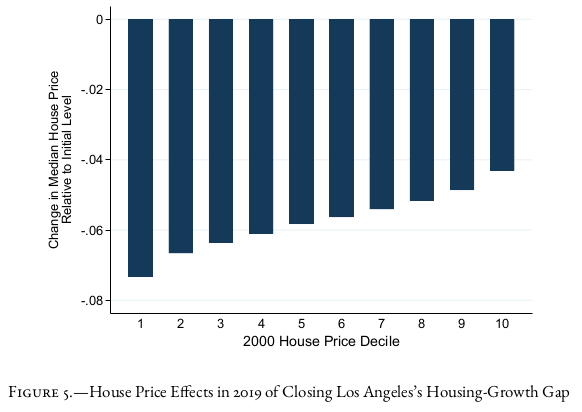
In his paper, Nathanson builds a housing ladder model of Los Angeles, with homes grouped into ten quality segments. Since LA builds less housing than average, he runs a simulation where its housing stock grows at the same rate as an average metro. This increases the metro housing stock by 12%, with a majority of the new housing being built in the top three of the ten quality segments. But through vacancy chains, this high-end supply reduces prices across the housing ladder, with the largest price decrease actually occurring in the bottom quality segment (see his Figure 5 below).6
Abramson and Landvoigt also use their model to show a vacancy chain. They run a simulation adding housing to only the highest quality segment. This allows rich households to upgrade and free up their original homes, starting a chain of moves that reduces housing demand in all lower segments. This exercise is even starker than Nathanson’s, but again, the result is lower prices across the entire ladder.
Mense (2025) provides empirical support for the prediction that high-end supply can reduce prices down the ladder. He uses variation in the construction of single-family houses driven by wintry weather in Germany. The main result is that a 1% increase in new completions lowers average asking rents by 0.19%; and confirming the vacancy chain mechanism, rents fall in all ten quality groups (deciles). In contrast to Nathanson’s figure above, Mense reports a smaller effect at the bottom of the ladder: rents fall by 0.13% in the bottom quality decile, and by 0.28% in the top decile. The common finding is that new supply has benefits across the market.7
Low-end demand causes an upward demand cascade
Given that high-end demand can cascade down and raise low-end rents, can the reverse happen, where an increase in low-end demand raises high-end rents? Surprisingly, yes. In a recent working paper, Nikolakoudis (2024) gives an example of this, for the special case of a demand increase that increases income but doesn’t change the number of households.
Here, adding purchasing power at the bottom of the ladder can raise rents at all rungs above, even though no one changes their housing situation. When people at the bottom can bid more, buyers in the middle need to pay more to avoid being outbid. In turn, buyers at the top end also need to pay more to outbid people from the middle. Like an auction where someone else starts bidding, you need to spend more to remain the highest bidder.8
For empirical evidence, Nikolakoudis uses county-level exposure to subprime mortgages as a low-end demand shock. He finds that over 2002-2005, new mortgages were concentrated in lower-income ZIP codes within a county. However, housing prices also increased in high-income ZIP codes, consistent with a spillover effect moving up the housing ladder.
Low-end supply starts an upward vacancy chain
We’ve seen that adding high-end demand and supply can affect low-end prices, and even that low-end demand can raise prices at the top of the ladder. Are there upward vacancy chains, where adding low-end supply reduces high-end prices? This would happen when people living in high-end housing want to downgrade, like seniors downsizing.
The answer seems to be yes. In his paper, Mense also builds a housing ladder model of Berlin. He shows an upward vacancy chain by simulating a supply increase in the bottom two deciles of housing quality (through tax-funded subsidized housing). This directly reduces rents in those deciles, but also leads to lower rents in all higher segments; see his Fig 5e below.
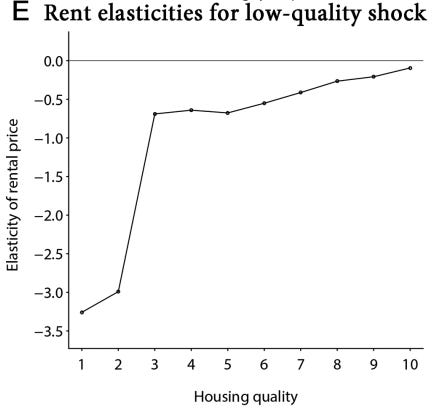
Mense’s model does not explicitly use vacancy chains, but a chain of downgraders is a plausible interpretation. There’s also consistent evidence from vacancy chains initiated by new social housing. Bratu, Harjuna, and Saarimaa (2023) (published, working paper) show that in Helsinki, around 15% of movers are from rich households and around 10% are from rich neighborhoods (see Fig 4 in the working paper). This could mean people are moving down the housing ladder in response to new social housing. So we have some evidence for upward vacancy chains.9
Conclusion: policy implications
A common argument is that we don’t have a housing shortage in general; instead, we have a shortage of affordable, low-end housing. But as we’ve seen, high- and low-end housing markets are connected. Increases in high-end demand have spillover effects on lower rungs of the housing ladder, meaning the shortage of low-end housing is partly caused by a lack of high-end homes.
Hence, affordable housing policy should promote both market-rate and subsidized housing, instead of treating them as solutions to unrelated problems. We can upzone to produce high-end housing for free, and this indirectly improves low-end affordability by starting vacancy chains and preventing demand cascades.10 And we can use tax revenue to directly fund low-end social housing. If you care about housing affordability, the natural strategy is to “do both”.
The term ‘filtering’ is sometimes used for these housing ladder spillover effects. I avoid this usage, since ‘filtering’ can also mean how a home moves across the income distribution. A home filters down when the next occupant is poorer than the initial occupant, and filters up when the next occupant is richer. See my writeup here.
What about cutting development taxes to get more housing supply? This is also not trickle-down. When taxes make a project infeasible, no housing is built and no tax revenue is collected. The tax acts as a deterrent. When we remove the tax and housing is built, there’s also no tax revenue (though we do now collect property taxes). So removing the tax doesn’t negatively impact the public budget. In contrast, income tax cuts do reduce tax revenue, since income taxes generally do not cause people to stop working altogether.
Nathanson also builds a housing ladder model, but doesn’t use it to show a demand cascade. (He told me this is too obvious!)
See Figure 5, policy B. The simulation actually involves two changes: converting high-end housing into low-end, and increasing the low-end housing supply. The two policies have opposing effects: adding low-end supply reduces low-end rents, but removing high-end supply causes a demand cascade and raises rents. If we only removed top-end housing, the demand cascade would reach all of the way to the bottom of the ladder.
The demand increase comes from comparing homeowners looking to downsize from their trade-up home, who are on fixed rate versus adjustable rate mortgages. For example, on a 3% fixed rate, you don’t want to downsize if it means signing a new mortgage at 6%. But on an adjustable rate, you pay 6% if you downsize or not. So being on a fixed rate mortgage increases demand for trade-up homes, compared to having an adjustable rate mortgage.
This result is even more striking considering that the exercise actually reduces housing supply in the bottom two deciles. So the bottom-end price reduction from vacancy chains is enough to outweigh the price increase from decreased supply.
Nathanson emphasizes that migration attenuates the vacancy chain effect, since the vacancy is created in the mover’s origin city. But this just means the supply effect is spread over multiple locations. Moreover, migration attenuates the effects of a demand cascade in the same way: when poor people can move away to escape rising prices, local demand is reduced (and shifted to their destination city). If migration was not allowed, there would be no escape valve, and demand cascades would be even more potent at increasing prices.
Finally, Nathanson tests how adding new supply in a particular decile affects bottom decile rents. As you’d expect, the effect of new supply is stronger when it is added closer to the bottom. But what we really want to know is how upzoning would reduce low-end rents, since upzoning adds new supply for free. We can spend tax revenue on subsidized housing to add low-end supply, but this comes at the cost of raising taxes.
If high-end supply reduces low-end prices, what happens when we tear down old housing to build fancy new homes? Here the two effects counteract: reduced low-end supply raises low-end prices, while added high-end supply reduces them. Nathanson reports a breakeven threshold of 3x: when removing decile-2 units, we need to add three times as many decile-10 units to keep decile-1 prices unchanged.
Note that this is a case of spillovers without movement along the housing ladder: increased low-end demand raises prices in all segments, but no one upgrades to a higher segment. Intuitively, when low-end homes are more attractive, high-end housing must become cheaper to remain competitive. In terms of the assignment equilibrium, high-end prices must rise to maintain the income ranking of households (i.e., poor to low quality, rich to high quality).
Nikolakoudis also reports a “no trickle-down” result, where high-end demand shocks do not raise low-end prices. But he considers only demand shocks that raise income while holding population constant. If instead the demand increase is based on in-migration, such as rich tech workers moving in, then we expect a demand cascade. Moreover, even a pure income shock could have downward spillovers; for example, doubling the wealth of the top 1% causes them to buy second homes, which increases prices in lower segments.
Mense does not account for doubling-up, where people take on roommates in response to higher housing costs. We expect this to mute the upward spillover effects of low-end supply, because roommates undouble to fill the new housing, so no vacancy is created and the chain ends. So the rent reduction in deciles 3-10 could be overstated.
Another possibility is that high-end prices fall without anyone downgrading, through the substitution mechanism from Nikolakoudis; the threat of downgrading is enough to reduce high-end prices.
Moreover, new market-rate housing is not necessarily high-end housing: “In the Baltimore and DC metro areas, [...] over a third of recently built rental housing units are rented at rates that qualify as affordable [at 60% of median income].” See also Charlotte and Minneapolis. The hardest case in support of market-rate housing is to show that even high-end housing helps; so if market-rate housing is actually middle tier, the case is even stronger.